

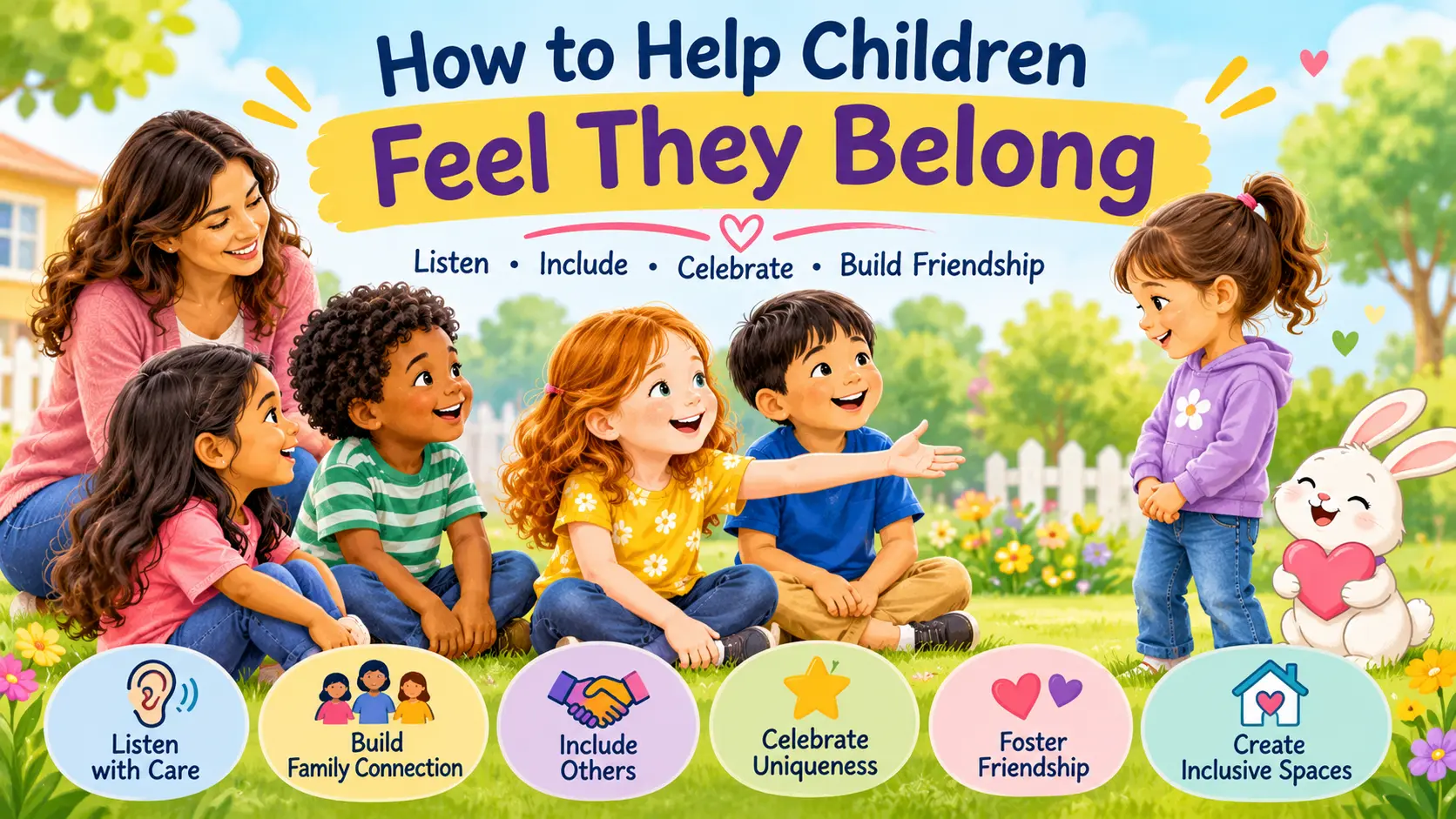
Belonging grows through repeated experiences of connection, acceptance, and inclusion.
Parents, caregivers, and educators can help children develop a stronger sense of belonging through small, intentional actions.
Children need opportunities to share their thoughts without feeling rushed or dismissed.
Set aside a few minutes each day to talk with your child about their experiences, interests, friendships, and worries.
Ask open-ended questions such as:
Listen to their answers with patience.
You do not always need to solve the problem immediately. Sometimes, simply knowing that an adult cares enough to listen helps a child feel understood.
Family rituals give children regular opportunities to experience connection and togetherness.
These rituals do not need to be elaborate. They might include reading a bedtime story, sharing a meal, taking an evening walk, or talking about the best part of the day.
Consistency can help children know what to expect and provide opportunities for meaningful conversations.
Invite children to contribute ideas, too. Let them choose a family game, select a bedtime story, or suggest an activity for the weekend.
These small choices communicate that their participation matters.
Children may want to be kind but need help understanding what inclusion looks like in everyday situations.
Show them simple ways to welcome others, such as:
Role-playing can make these skills easier to practice.
For example, ask your child, “Imagine someone comes to the playground and doesn’t know anyone. What could you say to help them feel welcome?”
Explore different responses together and praise thoughtful ideas.
Remember that inclusion should not depend on a child giving up their own boundaries. Children can be kind while still expressing their preferences and saying no when necessary.
Children sometimes worry that they must act, look, or think like everyone else to be accepted.
Help your child understand that meaningful friendships do not require people to be identical. Friends can have different interests, personalities, abilities, and perspectives while still enjoying one another’s company.
You might say:
“You don’t have to like the same things as your friends to belong.”
Or:
“You can be yourself and still find people who appreciate spending time with you.”
Be specific when recognizing your child’s qualities. Notice their curiosity, thoughtfulness, creativity, persistence, humor, or willingness to help.
The goal is not to convince children that they are better than others. It is to help them understand that they can appreciate themselves, respect differences, and build relationships without giving up what makes them who they are.
Friendship difficulties are a normal part of childhood, but they can feel overwhelming to a young child.
When a child says, “Nobody wants to play with me,” avoid immediately dismissing the statement or assuming you know exactly what happened.
Instead, gently explore the situation.
You could ask:
“That sounds lonely. Can you tell me what happened?”
Then help your child consider possible next steps.
They might invite another child to play, ask a trusted adult for help, practice joining a group, or spend time with someone who treats them kindly.
It is also important to recognize when exclusion becomes repeated or targeted behavior.
If your child regularly experiences bullying or social isolation, work with their teacher or another trusted adult to understand the situation and develop a plan to help them feel safe and supported.
Children should not be expected to manage persistent exclusion on their own.
Children are more likely to experience belonging when their surroundings communicate that everyone deserves respect.
At home, encourage family members to listen to one another, share responsibilities, and respect different opinions.
In classrooms, teachers can create opportunities for children to work with different classmates, contribute in different ways, and learn about one another’s interests.
Consider practical approaches such as:
Inclusive environments do not mean that every child must always feel comfortable or agree with everyone else.
They mean children are treated with dignity, supported through challenges, and given meaningful opportunities to participate.
Stories can help children explore social and emotional experiences in ways that feel accessible and engaging.
When children follow a character who feels different, struggles to make friends, or discovers the importance of kindness, they can reflect on those experiences without having to talk about themselves immediately.
Picture books can also give parents and teachers a shared starting point for discussing complicated feelings.
After reading a story, ask questions such as:
Allow children to answer in their own words. There is no need to turn every story into a formal lesson.
Sometimes, a gentle question and a thoughtful conversation are enough to help a child connect the story to their own experiences.
The You Matter Luma series, created by John R. Miles, uses children’s storytelling to explore self-worth, kindness, empathy, and emotional growth. Through its characters and their experiences, the series gives families opportunities to talk about what it means to feel accepted, recognize the value of others, and understand that every person deserves care and respect.
Discover how the You Matter Luma book series helps teach children that they matter through engaging stories and meaningful life lessons.
Every child expresses connection differently. Some children are naturally outgoing, while others prefer quieter relationships or need more time to feel comfortable in a group.
Rather than expecting every child to behave the same way, look for patterns that suggest they feel accepted and supported.
A child who experiences a sense of belonging may:
These are possible signs, not a checklist or a guarantee.
A child may feel a strong sense of belonging at home but struggle socially at school. Another child may have a close friend while still feeling uncomfortable in larger groups.
Shyness, quietness, or a preference for spending time alone does not automatically mean a child feels excluded.
What matters is whether the child has meaningful opportunities for connection, feels safe being themselves, and has trusted people they can turn to when they need support.
Hearing your child say, “Nobody likes me,” or “I don’t have any friends” can be painful.
Your first instinct may be to reassure them immediately, but it can help to pause and understand what they are experiencing.
Here are five supportive steps you can take.
Listen before offering solutions. Give your child time to explain what happened. Avoid interrupting or minimizing their feelings.
Acknowledge the emotion. Let them know that feeling left out can hurt. You do not have to agree with every conclusion they draw to recognize their disappointment.
Explore the situation together. Ask gentle questions to understand whether this was an isolated disagreement, a difficulty joining a group, or a repeated pattern of exclusion.
Help them identify possible next steps. Depending on the situation, this might mean practicing how to approach another child, arranging time with a compatible friend, or asking a teacher for support.
Reinforce their sense of worth. Remind them that another person’s decision does not determine their value.
You might say:
“Sometimes friendships can be difficult, and it hurts when we feel left out. You deserve kindness and respect. Let’s think together about what might help.”
If your child experiences persistent loneliness, significant distress, or repeated bullying, consider involving their teacher, school counselor, pediatrician, or another qualified professional as appropriate.
The goal is not to promise that everyone will always include them. It is to help them build supportive connections, develop practical social skills, and understand that they deserve to be treated with care.
For additional guidance, read our article on how to help a child feel like they matter.
Social-emotional learning, often called SEL, helps children develop skills for understanding emotions, building relationships, making thoughtful decisions, and responding to social situations.
Belonging connects naturally with these skills.
When children feel included, they have opportunities to practice communicating, cooperating, resolving disagreements, and understanding different perspectives.
When they help someone else feel included, they can practice empathy, kindness, and responsible decision-making.
For example, a classroom activity that invites children to share their favorite games can help them discover common interests while appreciating differences.
A discussion about a character who feels left out can help children recognize emotions and consider how their actions affect others.
These activities are most meaningful when they are supported by an environment where children experience respect and inclusion in everyday interactions.
Belonging should not be treated as a skill children must develop entirely on their own. Adults also have a responsibility to create relationships, routines, and environments where children have genuine opportunities to feel accepted.
Explore more ideas in our guide to social-emotional learning activities for kids that encourage empathy.
Belonging helps children feel accepted, valued, and connected to others. Supportive relationships can contribute to children’s sense of self-worth, confidence, emotional well-being, and ability to build positive relationships.
Parents can help children feel they belong by listening to their feelings, creating consistent family rituals, celebrating their individuality, encouraging healthy friendships, and showing them that love and respect do not depend on perfection.
Belonging means feeling accepted for who you are. Fitting in can sometimes involve changing your behavior or hiding parts of yourself to gain acceptance. Healthy belonging allows children to connect with others while remaining true to themselves.
Teachers can promote belonging by creating inclusive classroom routines, encouraging respectful communication, providing different ways for children to participate, addressing bullying, and helping students develop empathy and cooperation.
Listen calmly, acknowledge your child’s feelings, and ask gentle questions about what happened. Help them explore ways to build connections and involve a trusted teacher if exclusion is repeated or becomes bullying. Reassure your child that their worth is not determined by whether a particular group includes them.
Yes. Children’s books can introduce experiences involving friendship, inclusion, differences, and empathy. Discussing characters’ feelings and choices can help children explore what belonging means and consider how they can make others feel welcome.
Children can begin developing a sense of connection and acceptance in early childhood. For children ages 4–8, everyday family interactions, play experiences, classroom routines, and stories provide age-appropriate opportunities to explore friendship, inclusion, and respect.
Belonging begins with a simple but powerful message: You are welcome here. Your feelings matter. You deserve kindness, and you do not have to be someone else to be valued.
Children do not need perfect friendships or constant approval to develop a sense of belonging. They need caring adults who listen, environments that welcome differences, and opportunities to build meaningful relationships.
Parents can nurture belonging through everyday conversations. Teachers can encourage it through inclusive classroom practices. Stories can help children understand what it feels like to be accepted and how their actions can help others feel welcome.
Most importantly, children need to know that their worth is not measured by how popular they are, how well they perform, or how closely they resemble their peers.
Every child has something valuable to contribute.