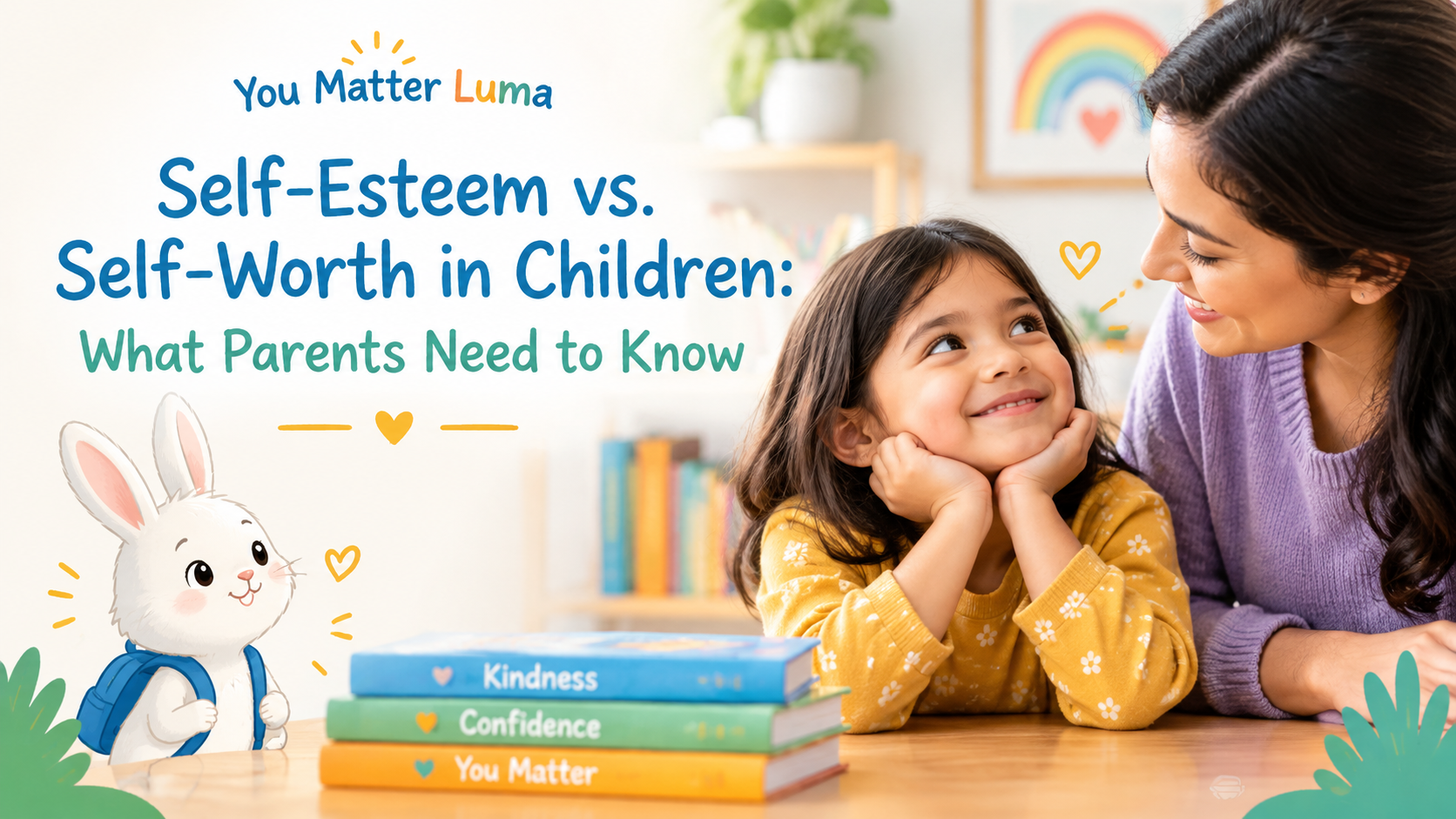
Self-esteem vs. self-worth in children is an important distinction for parents to understand. The former refers to the way a child perceives himself, his skills and accomplishments whereas the latter is defined as an intrinsic value of the child regardless of his actions. Self-esteem and self-worth both are significant aspects of a healthy development of a child emotionally and both are highly linked to building self-worth and developing skills of emotional intelligence in children.
Being able to help your children distinguish between self-worth and self-esteem will help them to become confident, resilient and have better relationships. You can do it by having talks with your child, practicing positive parenting techniques and reading interesting stories. You can explore social-emotional learning for kids to find out more about it.
Self-respect and self-worth are very much related concepts, but they do differ somewhat.
Self-respect is commonly linked with the evaluation that children make regarding themselves in relation to various situations in which they find themselves, including their ability and strengths. Self-worth is about believing in one’s own value and deservability of love, care, and respect no matter what one’s accomplishments are.
For instance, children might feel very satisfied after completing a complex puzzle. This can boost self-respect. But if children consider themselves worthy only in case they do well, their value can depend upon their performance.
Children who have better self-worth can be upset over the puzzle without being convinced of being a failure.
| Self-Esteem | Self-Worth |
| How children feel about themselves | The belief that they have inherent value |
| Can change with experiences and feedback | Provides a deeper sense of personal value |
| May grow through learning and accomplishments | Is reinforced when children feel accepted beyond their achievements |
| Example: “I’m proud that I learned to ride my bike.” | Example: “I’m still important even when I cannot do something yet.” |
The key takeaway: Children can learn to feel proud of what they do while understanding that who they are matters just as much.
Early childhood offers plenty of chances for kids to form self-concepts. The reaction from adults to failures, emotions, obstacles, and success plays an important role in shaping how the child perceives these situations.
In case kids feel valued and supported, they get a chance to cultivate their secure self-concept. That doesn’t mean they will always feel confident and won’t experience unpleasant emotions. But they have an opportunity to learn that failure, mistakes, and obstacles do not decide their worth.
1. They Help Kids Handle Mistakes
It’s not easy for kids to cope with the feeling of frustration and disappointment. In some cases, a mistake can seem very huge for a kid.
The one whose self-concept is tied up with success can conclude “I failed to answer the question correctly, thus I’m not intelligent.”
The one who is developing his/her self-concept will learn that “I’ve made a mistake, but I still have the chance to improve.”
Parents can help kids by treating mistakes as an occasion to gain knowledge rather than a cause for shaming.
2. They Help Children Be Confident and Not Afraid to Try New Things
Confidence stems from having the chance to learn and develop by experiencing things that can be challenging.
Yet, confidence doesn’t always involve believing that you are better than other people at something. Confidence involves being aware that it is fine to be a beginner.
You can support your child’s healthy development by noticing their effort, their curiosity, patience, and the desire to try.
For more practical ideas, read our guide on how to build self-worth in children.
3. They Are Helping Children Become Emotionally Aware
Your children go through different emotions, both positive, like joy, and negative ones, like being sad, jealous, scared, angry, or embarrassed.
Children need to have chances to understand their emotions without thinking that being uncomfortable means that they are bad.
For instance, if a child feels jealous because a friend was praised, a parent can help them see that jealousy is just another emotion.
You can say, “It can be difficult when other people get attention. You can be disappointed and still be happy for your friend.”
This approach helps children separate their feelings from their identity and actions.
Explore our article on the signs of emotional intelligence in kids to learn more about how children recognize and respond to emotions.
Praise can be encouraging, but children also need to know that they are valued when nobody is applauding them.
The goal is not to avoid celebrating achievements. It is to balance encouragement with acceptance, connection, and opportunities to learn.
Let children know that your love is not something they must earn by behaving perfectly, getting good grades, or making you happy.
You might say:
These simple messages can help children understand that mistakes may require correction, but they do not make a child less worthy of love.
Instead of focusing exclusively on results, notice the process behind them.
For example, rather than saying only, “You are the smartest child in the class,” try saying, “You kept working on that problem even when it was difficult.”
You can also recognize kindness, patience, honesty, and cooperation.
This helps children understand that learning and personal growth matter more than always being the best.
Children need to know that their emotions are welcome, even when their behavior needs guidance.
You can say, “It is okay to feel angry. It is not okay to hit your brother. Let’s find another way to show how upset you are.”
This response communicates two important messages: feelings do not make children bad, and their actions still have consequences.
It also gives children an opportunity to learn emotional regulation and responsibility.
Age-appropriate independence helps children develop a sense of capability.
Invite your child to choose a book, select between two outfits, help prepare a snack, or decide how to organize their toys.
When children make choices and solve small problems, they gain opportunities to practice decision-making and learn from experience.
Offer support when needed, but allow room for manageable challenges.
Comparisons can make children feel that their value depends on being better than someone else.
Statements such as “Why can’t you be more like your sister?” may discourage children and create unnecessary competition.
Instead, focus on the child’s individual progress.
You might say, “Last month, this felt difficult for you. Look at what you can do now.”
Children can celebrate another person’s success without feeling that someone else’s achievements reduce their own worth.
Children learn from the way adults talk about themselves.
If you make a mistake, avoid harsh statements such as, “I’m so stupid.” Instead, model a kinder response: “I made a mistake. I’ll learn from it and try again.”
You can also talk openly about feeling disappointed, taking a breath, asking for help, and making things right.
These everyday examples show children that people can be imperfect and still deserve patience and respect.
Stories give children a safe way to explore feelings, relationships, mistakes, and difficult situations. When children connect with a character, they can consider how that character feels and what might help them respond differently.
A picture book can also provide parents and educators with a natural starting point for conversations that might otherwise be difficult to begin.
Stories about self-worth can help children explore questions such as:
When choosing a children’s book about confidence or self-esteem, look for stories that:
Books are most useful when adults make space for children to share their own thoughts rather than simply explaining the lesson.
For more ideas, explore our guide to children’s books that teach kindness and empathy.
You Matter, Luma is a children’s picture book by John R. Miles for young readers ages 4–8. The story features Luma the Bunny and explores the importance of recognizing personal value, kindness, confidence, and belonging.
Its central message is that children matter for who they are, not simply for what they accomplish or how others see them.
Parents and educators can use a story like You Matter, Luma as a starting point for discussing what makes each child unique, how it feels to be overlooked, and why every person deserves kindness and respect.
After reading together, consider asking:
These questions help connect the story’s themes with children’s everyday experiences.
Parents and educators do not need complicated exercises to encourage healthy self-beliefs. Small, repeated activities can create meaningful opportunities for reflection and connection.
Ask your child to name a few things they enjoy doing, such as drawing, running, building, or singing.
Then ask, “What else makes you you?”
Help them consider their interests, feelings, relationships, imagination, and ways of caring for others.
Explain that being good at something can feel wonderful, but a person’s value is not limited to their talents.
At the end of the day, invite your child to reflect on one kind thing they noticed, received, or did.
Ask questions such as:
The goal is to encourage awareness and empathy, not to make children feel they must earn approval through good deeds.
When your child encounters a setback, help them name what happened, how they feel, and what they might try next.
For example:
What happened? “My tower fell down.”
How do I feel? “I’m frustrated.”
What can I try? “I can make the bottom wider.”
Finish with a reminder: “Your tower falling down does not change how important you are.”
This activity connects problem-solving with a stable sense of self-worth.
Choose a regular moment, such as bedtime, to remind your child that they are loved and valued.
You might say, “Today had some hard moments, but you are loved. Tomorrow is another chance to learn, play, and grow.”
For young children, repeated messages paired with consistent caring behavior can help reinforce a sense of security and belonging.
Occasional self-doubt is a normal part of growing up. Children may compare themselves with friends, feel embarrassed after a mistake, or worry about fitting in.
However, it may be helpful to offer additional support if a child frequently describes themselves as worthless, avoids activities because they fear failure, becomes extremely distressed by ordinary mistakes, or regularly expresses beliefs that nobody likes or values them.
These behaviors do not automatically indicate a specific problem, but persistent or intense distress deserves attention.
Parents can begin by listening calmly, acknowledging the child’s feelings, and avoiding dismissive responses such as “Don’t be silly” or “You have nothing to worry about.”
If the distress continues, interferes with everyday activities, or affects relationships and school participation, consider speaking with a pediatrician, school counselor, or qualified child mental health professional.
The most important message is that children do not need to feel confident every day to be valuable. They need caring adults who help them navigate difficult feelings while reminding them that they are worthy of support.
Understanding self-esteem vs. self-worth in children helps parents look beyond achievements and focus on the whole child.
Self-esteem can grow as children develop skills, experience success, and learn to handle challenges. Self-worth is reinforced when children understand that their value does not disappear when they fail, feel upset, or need help.
Parents can nurture both through unconditional love, realistic encouragement, emotional acceptance, age-appropriate independence, and stories that invite meaningful conversations.
For families exploring these themes, You Matter, Luma by John R. Miles offers a child-friendly opportunity to talk about self-worth, kindness, confidence, and belonging.
Every child deserves the chance to grow, make mistakes, learn, and discover their strengths while knowing one essential truth: they matter, exactly as they are.