There are moments in childhood that arrive quietly but rearrange everything that comes after them.
For me, one of those moments was a summer afternoon that ended with a traumatic brain injury. Healing childhood trauma like mine began years later when I finally understood the deeper wound: the silence that followed, the belief that my voice and my presence only mattered if I performed perfectly.
I began to notice how quickly the world shifts when you sound different. Conversations move forward without you. People grow impatient with pauses. Attention drifts. Sometimes laughter appears, even when it is not meant to wound. Over time, I absorbed a lesson that many children learn in far less visible ways. If being heard is uncertain, being quiet feels safer.
That belief followed me into adolescence, into adulthood, and eventually into success. What I did not understand at the time is that many people carry similar internal narratives shaped not by a single event, but by years of emotional neglect, inconsistent attention, or environments where love felt tied to performance.
Healing childhood trauma often begins with a single, quiet recognition: these experiences do not simply fade with age. They do not vanish when we outgrow the playground or leave home. Instead, they settle into the background like invisible rules—unspoken agreements our younger selves made about worth, belonging, and identity. Those rules quietly shape how we move through the world long after the original events are over.
For some, the rule is “Love is earned through performance.” For others, it’s “Safety comes from disappearing.” For many, it’s a combination: “If I’m useful, I’m safe. If I’m visible, I’m vulnerable. If I’m perfect, I’m worthy.” These beliefs were survival strategies formed when the brain was still developing, when the need to belong felt as essential as air.
The tragedy is not that we learned these rules. The tragedy is how faithfully we continue to obey them, even when they no longer serve us.
Healing childhood trauma requires us to gently surface these invisible rules and examine them in the light of who we are now. This is not about blaming the child who made them, nor is it about rejecting the strength it took to survive. It is about giving that child permission to rest. Permission to stop performing for safety. Permission to exist without apology.
Childhood is the environment where we build our earliest understanding of who we are allowed to be. Psychologists often describe early self-concept as highly impressionable. I think of it more like wet cement. Every repeated experience leaves an imprint that hardens over time.

Children who feel consistently seen and emotionally safe develop an internal stability that allows them to explore the world without questioning their value. Children who grow up navigating unpredictability or invisibility often develop something equally powerful but far more complicated. They become experts at adaptation.
Some children learn to disappear emotionally to avoid rejection or conflict. Others move in the opposite direction and become exceptional performers, mastering achievement as a way to secure attention and approval. Both responses are brilliant forms of survival. Both can quietly distance individuals from their authentic voice.
This is what I have come to call the speech impediment of the soul. It is not the loss of words. It is the quiet belief that your voice does not matter unless it produces results.
Many adults carry this belief without realizing it. They build impressive careers, become dependable leaders, and earn admiration from others, yet privately wrestle with a persistent sense of being unseen. The question beneath their ambition is rarely spoken out loud. If I stop achieving, will I still matter?
Success can amplify this tension of trying to heal childhood trauma rather than resolve it. Applause validates performance, but it cannot heal a wound that formed around belonging.
Modern life intensifies this struggle in ways previous generations never experienced. We live in a culture obsessed with optimization. Productivity is tracked, progress is measured, and personal value often feels tied to output. This environment rewards the exact survival strategies that invisibility teaches.
For individuals shaped by early emotional wounds, achievement becomes both shield and identity. The more they accomplish, the safer they feel, at least temporarily. Yet the finish line keeps moving because performance addresses symptoms rather than origins.
Research into mattering, the psychological experience of feeling significant to others, offers important insight into why this cycle feels so exhausting. Studies consistently show that individuals who feel genuinely valued develop stronger resilience, deeper emotional stability, and healthier relationships. Conversely, those who experience low mattering are more vulnerable to anxiety, depression, and chronic loneliness, even when they appear externally successful.
Attention is the language through which mattering is communicated. Children interpret consistent presence as proof of their importance. Adults continue to seek that same validation, often through achievement when presence feels uncertain.
In today’s hyperconnected world, presence has become increasingly rare. Conversations compete with notifications. Relationships unfold alongside multitasking. Over time, people adapt by sharing less of themselves, protecting vulnerabilities, and measuring connection through accomplishments rather than emotional safety.
The result is a society where visibility is constant but genuine recognition is scarce.
Healing childhood trauma does not require rewriting the past or discarding the strengths built through survival. Many of the qualities that emerge from early adversity, discipline, determination, and resilience become extraordinary assets later in life. The work of healing is learning to separate those strengths from the belief that worth must always be earned.
One of the most powerful ways to begin this process is by examining how self-worth fluctuates. Do you feel valuable only when producing results, or can you experience worth during rest and stillness? Do you feel anxious when you are not actively proving usefulness? These questions are not meant to create judgment. They create awareness, which is where change begins.
Another path toward healing childhood trauma lies in building what I describe as the wordless tie. This bond forms when someone experiences your full attention without needing to earn it. Ten minutes of undistracted presence can communicate significance more deeply than hours of distracted interaction. Children feel it instinctively, but adults crave it just as deeply.
The wordless tie does more than strengthen relationships. It reshapes identity. When individuals consistently experience presence, they begin to internalize a different narrative about their value. They learn that belonging is not conditional, and voice does not need to be justified through performance.
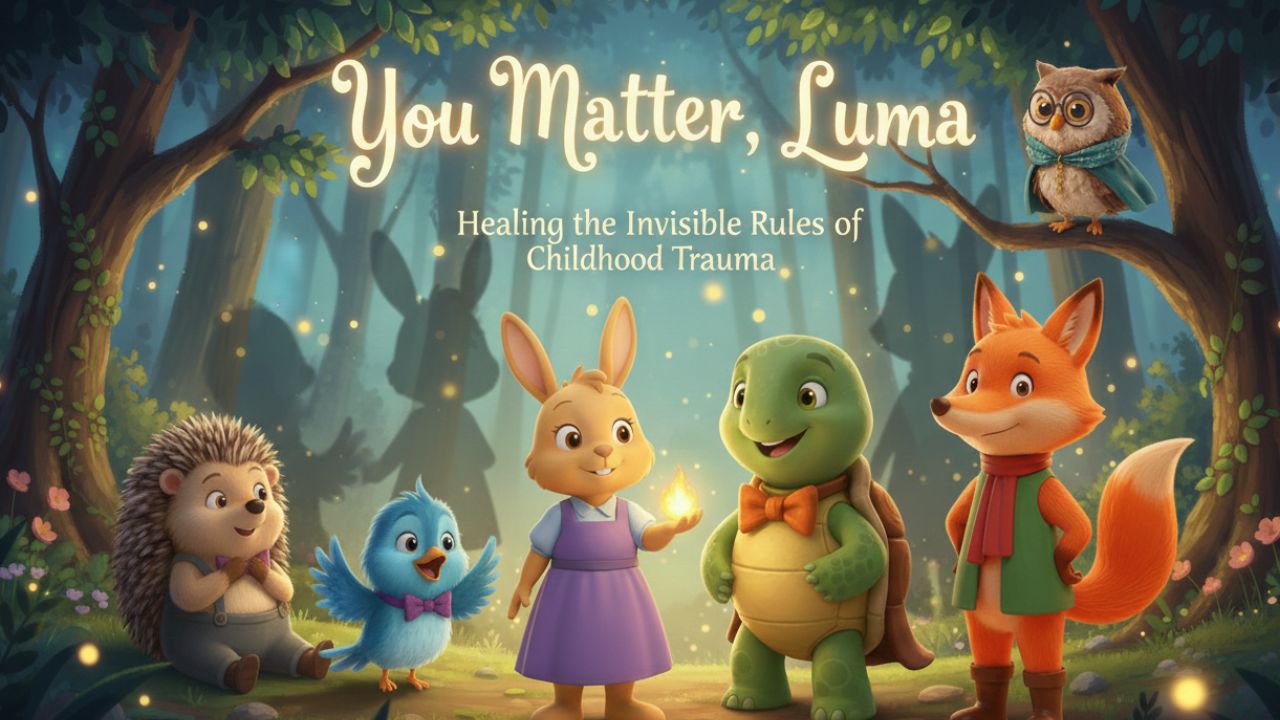
That’s why I wrote You Matter, Luma—a gentle story for ages 4–8 that plants the seed of intrinsic worth before the performance script takes hold. When parents or educators read it with a child, they’re also speaking to their own inner five-year-old: “You matter—no matter what. The trade is over.” Pre-order the book and start building that wordless tie today.
This shift has a generational impact. When adults reclaim their intrinsic worth, they model a new standard of connection for children, partners, colleagues, and communities. They replace performance-driven belonging with presence-driven belonging. Over time, this transformation can interrupt cycles of adult invisibility that might otherwise continue for decades.
Healing from childhood trauma often unfolds quietly. It happens in moments of self-compassion, in conversations where listening replaces fixing, and in relationships where attention becomes a deliberate act of love. It rarely feels dramatic or cinematic. More often, it feels like slowly remembering something that was always true.
You were never broken. You were adapting to survive an environment that could not fully hold you.
Healing childhood trauma is about returning to the voice that existed before silence felt necessary and learning, often for the first time, that your worth has never depended on how well you perform for belonging.
If this resonates, start small: offer 10 minutes of undistracted presence today. And if you’d like a gentle way to plant this truth early for a child (or remind your own inner child), explore You Matter, Luma. It was written for exactly this moment.