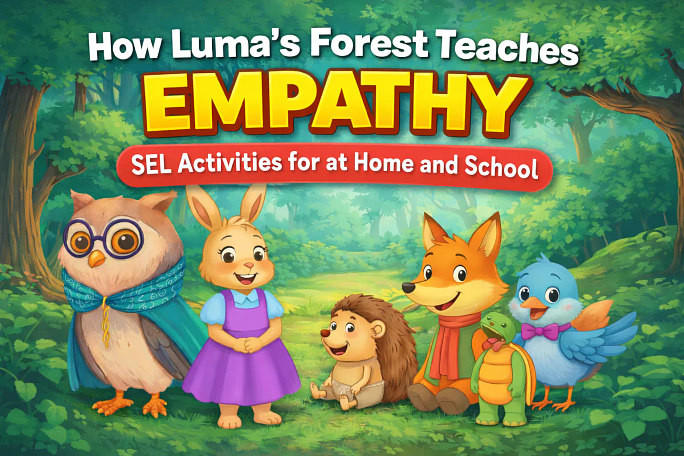
Social-emotional learning has become a cornerstone of modern education, and for good reason, with resources like You Matter, Luma teaches empathy helping children build essential emotional skills. Emotional intelligence early on helps children to have stronger relationships, overcome problems, and become more compassionate. Kids do not need to have complex activities in SEL.
Stories that serve in imparting children with important skills in life and at the same time stimulating their imaginations provide the best lessons sometimes. You Matter Luma is a perfect experience of empathy education and SEL activities for kids because of the interactive characters and the situations that people can relate to.
Understanding Social-Emotional Learning and Empathy
Social-emotional learning includes five key competencies, which are self-awareness, self-management, social awareness, relationship skills, and responsibility for decision-making. Of these, one key component that comes under social awareness and is a vital cornerstone for all healthy relationships is “empathy.” Storybook series can become a powerful tool for developing these core competencies for kids.
Empathy refers to the quality of understanding and sharing the feelings of another. This aspect may be complex for children. In the initial stages of life, they tend to be egocentric. This quality of being egocentric makes it complex yet necessary for the development of empathy in children. Studies have indicated the positive influence of children with good empathy skills when they learn from quality storybooks for kids.
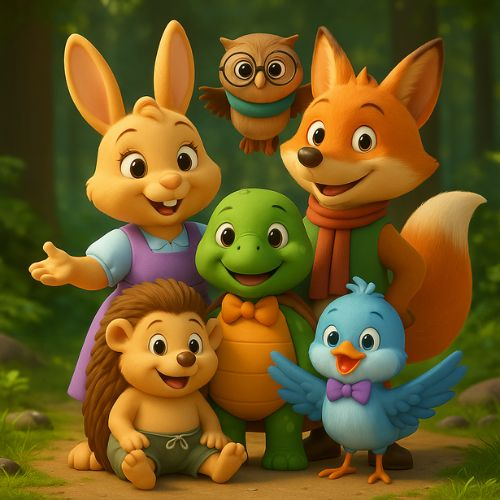
The characters in You Matter, Luma, provide concrete examples of empathy in action. When children see characters facing challenges, making mistakes, and supporting one another, they begin to recognize similar situations in their own lives. This connection between story and reality makes abstract emotional concepts tangible and actionable, which is why character-driven storybook series for kids are such effective tools for teaching empathy.
Why Stories Are Powerful Tools for Teaching Empathy
Stories have been the teaching aids of choice for the human species for the past four thousand years, and recent studies have proven their efficacies as teaching aids. When children are exposed to stories, their brains treat the experiences of the characters as if the experiences belonged to the children themselves.
Self-esteem picture books such as “Luna and the Magic Paintbrush” and others offer opportunities for youngsters to navigate various viewpoints without consequences within their world. A child can discover how it is to feel left out, to show courage in overcoming fears, to defend a friend, all from within their reading nook.
The emotional investment children develop with recurring characters enhances this learning. When children care about what happens to Luma, they’re more likely to internalize the lessons those characters model. This is why children’s book sets featuring the same characters across multiple stories can be particularly effective for SEL development.
Practical SEL Activities for Kids Using Luma’s Forest
Emotion Recognition Activities
Begin with simple exercises to recognize basic emotions. As children read a chapter or story in You Matter Luma, they’re asked to identify which emotion the characters felt. Make emotion cards with pictures of faces to demonstrate happiness, sadness, frustration, happiness or joy, concern or worry, and pride.
Ask the children to match the ripple cards with the events of the story. Kindergarten kids should be taught about simple feelings, while older kids can learn about complex feelings such as disappointment, embarrassment, and determination.
To further develop this concept, ask the children to draw their own emotion faces or construct an emotion wheel. When children develop educational tools themselves, they become more invested in the lesson being taught.
Perspective-Taking Exercises
Empathy exercises for kids should challenge them to see situations from multiple viewpoints. After reading about a conflict or challenge in Luma’s Forest, guide children through perspective-taking activities.
Create a simple graphic organizer with three columns: “What happened,” “How Character A felt,” and “How Character B felt.” This visual tool helps children understand that the same event can affect different people in different ways.
Social Emotional Learning Games Inspired by Luma’s Forest
Empathy Charades
Turn traditional charades into an exercise for developing empathy. Scenario cards from Luma’s Forest can contain descriptions of cases where kindness, bravery, or empathy was displayed. The children act out the scene while others try to guess both what’s occurring and how the characters feel.
This game extends the practice of emotional recognition and incorporates the aspects of SEL in a more active and enjoyable manner. This game will function perfectly in a class or at home with no additional materials except the scenario cards.
The Kindness Challenge
Create a kindness challenge inspired by actions from stories about courage. When children see Luma or other characters performing kind acts, challenge them to complete similar actions in their own lives. Keep a class or family kindness chart where children add a sticker or note each time they perform an empathetic act.
This activity bridges the gap between reading about empathy and practicing it. Children begin to see themselves as capable of the same compassion demonstrated by their favourite characters.
Emotion Matching Memory Game
Each pair of cards has one with a situation illustrated or described, while the other has an emotional expression. Kids take turns flipping cards in attempts to pair situations with corresponding emotional reactions. Start with scenarios from “Luma’s Forest” that the kids have already read to familiarize them with the context.
This game builds emotional literacy while allowing for repetition to reinforce learning. For younger children, you can begin with six to eight pairs. For older children, they can handle more complicated situations as well as more subtle shades of emotion.
Implementing SEL Activities at Home
Parents have an important role to play in developing EQ. The opportunities available in the family environment for practicing EQ, particularly when combined with reflection on stories such as “You Matter Luma,” are infinite.
Establish a bedtime routine involving reading from children’s book collections involving Luma, culminating in conversations on the characters’ emotions and decision-making. Encourage open-ended questioning instead of Yes/No questions: “What should Luma do?” instead of “Is Luma right? “Practice empathy yourself. When you practice empathy, think aloud: “I saw Mrs. Johnson looked angry today. I recall that I used to feel angry too whenever I had a lot on my plate. Acting on empathy helped me a
Classroom Integration of SEL Activities
Educators can incorporate the Forest of Luma into several elements of their curriculum, meaning social-emotional learning becomes part and parcel of the school day rather than a standalone lesson. Begin each day by having a morning meeting during which a short reading of You Matter Luma is offered, along with an empathy question. This is a good, considerate tone of the day and provides consistent SEL practice.
Establish specialised learning centres for various SEL skills. An empathy centre may have Luma character puppets, emotion cards, scenario cards to role-play, and story situation writing prompts. Turn children over centres, where the emotional intelligence concepts can be practiced.
Similarly, incorporating SEL activities for kids into literacy instruction by using Lumas Forest in reading comprehension lessons centered on character motivations, emotional arcs, and relationship-building. When children can determine the reasons why these characters make these decisions, they are applying the same analytical ability in life that they would in social situations.
Activities for Different Age Groups
SEL in Kindergarten
Hands-on and multisensory methods are required by young children. Puppets or stuffed animals may become the representatives of Luma characters. play out simple situations and ask children to recognize feelings based on facial expressions and body language.
Prepare an emotions corner using mirrors where the children can train to make various faces of different emotions. Relate these phrases to scenes in the narrations: Could you make a face like Luma did when they were proud?
Keep sessions brief, between ten and fifteen minutes long, and include movement. The combination of SEL and physical activity is emotion freeze dance, when children move freely, and after you declare an emotion mentioned in the story, they will freeze in a pose depicting the emotion.
First and Second Grade
This age group can handle more complex scenarios and begin to understand that people can feel multiple emotions simultaneously. Use Venn diagrams to explore how two characters might share some feelings while experiencing others differently.
Introduce simple journaling where children draw or write about times they felt similar emotions to story characters. This self-reflection builds self-awareness alongside social awareness. Create emotion timelines for stories, mapping how a character’s feelings changed throughout the narrative. This helps children understand that emotions are temporary and changeable.
Third Through Fifth Grade
Students of higher grade levels can participate in more sophisticated exercises of empathy targeting children. Essays involving perspective-taking Introduce assignments involving perspective-taking writing, in which they retell events of the stories in the perspectives of different characters or different emotional decisions.
Debate-style discussions surrounding character choices can be used, where children are encouraged to both defend opposing points of view even when they do not agree with them themselves. This modern outlook on perspective enhances empathy and critical thinking.
Design local service initiatives that are based on the values of the Forest of Luma. Children can practice empathy when they plan and perform the acts of kindness in their greater community.
Measuring Growth in Emotional Intelligence
Although emotional intelligence may seem challenging to quantify, there are a number of signs that show the improvement. In children who show the enhanced empathy, there will be enhanced conflict solving strategies with the ability to use words such as I understand or that must be hard in case of disagreements.
Pay attention to the use of more emotional words. Those children who have been exposed regularly to SEL activities and stories will cease to employ the good and bad as expressions of feelings but will use certain expressions such as frustrated, disappointed or relieved.
Reduce peer relationship problems. Children who possess a high degree of empathy incorporate others into their world more easily, react in a supportive way when friends are distressed and are more mature in tackling social problems.
Connecting Luma’s Forest to Broader SEL Curriculum
Luma Forest is used to supplement organized SEL curricula that is used in numerous schools. Narrative examples of abstract concepts are presented by the stories, and abstract skills are developed and assessed in formal curricula.
Finding the relations to Luma stories when teaching new ideas about SEL in the school curriculum, you should find something in common. When your program is self-regulation-oriented this month, find the instances when the characters were able to control strong emotions successfully. This supports learning in various forms.
Keep Luma characters as benchmarks in the year. When you are in a conflict, refer to the way the characters dealt with such like scenarios: “Remember when Luma felt left out? What did they do?” This forms mutual language use and illustrations that the entire class recognizes.
Resources for Continued Learning
Beyond Luma’s Forest, numerous resources support ongoing empathy development. Create a classroom or home library that includes diverse self-esteem picture books showing characters from various backgrounds facing universal emotional experiences.
Professional organizations like CASEL, which stands for Collaborative for Academic, Social, and Emotional Learning, offer free resources, including lesson plans, assessment tools, and research summaries. These materials can help structure your use of stories like Luma’s Forest within evidence-based frameworks.
Overcoming Common Challenges
Some children resist discussing emotions or dismiss empathy activities as “babyish.” For these children, emphasize the problem-solving aspects of emotional intelligence. Frame empathy as a superpower that helps navigate complex social situations, using examples from the stories where understanding others’ perspectives led to success.
When time feels limited, remember that SEL doesn’t require separate lesson blocks. Brief check-ins, quick discussions during transitions, and intentional language during everyday interactions all contribute to emotional intelligence development.
If children struggle to connect story situations to their own lives, use more explicit bridging. After discussing a Luma scenario, directly ask: “Has anything like this happened to you? How did you feel? What did you do?” These questions scaffold the connection between narrative and experience.
The Long-Term Impact of Empathy Education
The advantages of SEL activities to kids are not limited to elementary school. It has been shown that children who are well emotionally intelligent perform better in school, have healthier relationships, have a healthier mental status, and even earn higher incomes once they grow up.
Being exposed to empathy on a regular routine basis by reading stories such as the Forest by Luma with the help of deliberate exercises makes children acquire the said skills, which become automatic with time. The child who is able to think in a conscious way, how does my friend feel? eventually turns out to be the adult who inherently listens to the views of others.
Good ripple effects arise because of these competencies. Caring children grow up to be empathetic friends, supportive brothers, and above all caring partners and parents. Communities that are built based on empathy and compassion are developed by them. Apart from being emotional, such as textbooks and worksheets cannot be, social-emotional learning provides that: engaging stories. When children are concerned with Luma and friends they have deeper lessons in mind. When they observe characters being empathetic, they imagine that they can do the same.
Begin with one activity that suits you. Read a story, pose a question and listen to the answers of children. You will probably be impressed by their insight and touched by their growing compassion. All these little bits of bonding and contemplation add up to great development, a story and a conversation at a time.
FAQ
What are SEL activities for kids?
SEL activities help children build emotional skills like empathy, self-awareness, and relationship building through games, stories, and reflection suited for home or classroom use.
How does Luma’s Forest teach empathy to children?
Luma’s Forest teaches empathy through relatable characters and stories that show emotions, problem-solving, and kindness, helping kids understand feelings and perspectives naturally.
Are these empathy activities suitable for both home and school?
Yes, the SEL activities inspired by Luma’s Forest are flexible and easy to use at home or in classrooms, making them ideal for parents, teachers, and counsellors.
What age group are Luma’s Forest SEL activities best for?
Luma’s Forest SEL activities are designed for K–5 students, with adaptable exercises that support emotional learning from kindergarten through upper elementary grades.
Why are stories effective for teaching emotional intelligence?
Stories engage children emotionally, allowing them to practice empathy safely by connecting with characters, understanding emotions, and applying lessons to real-life situations.